
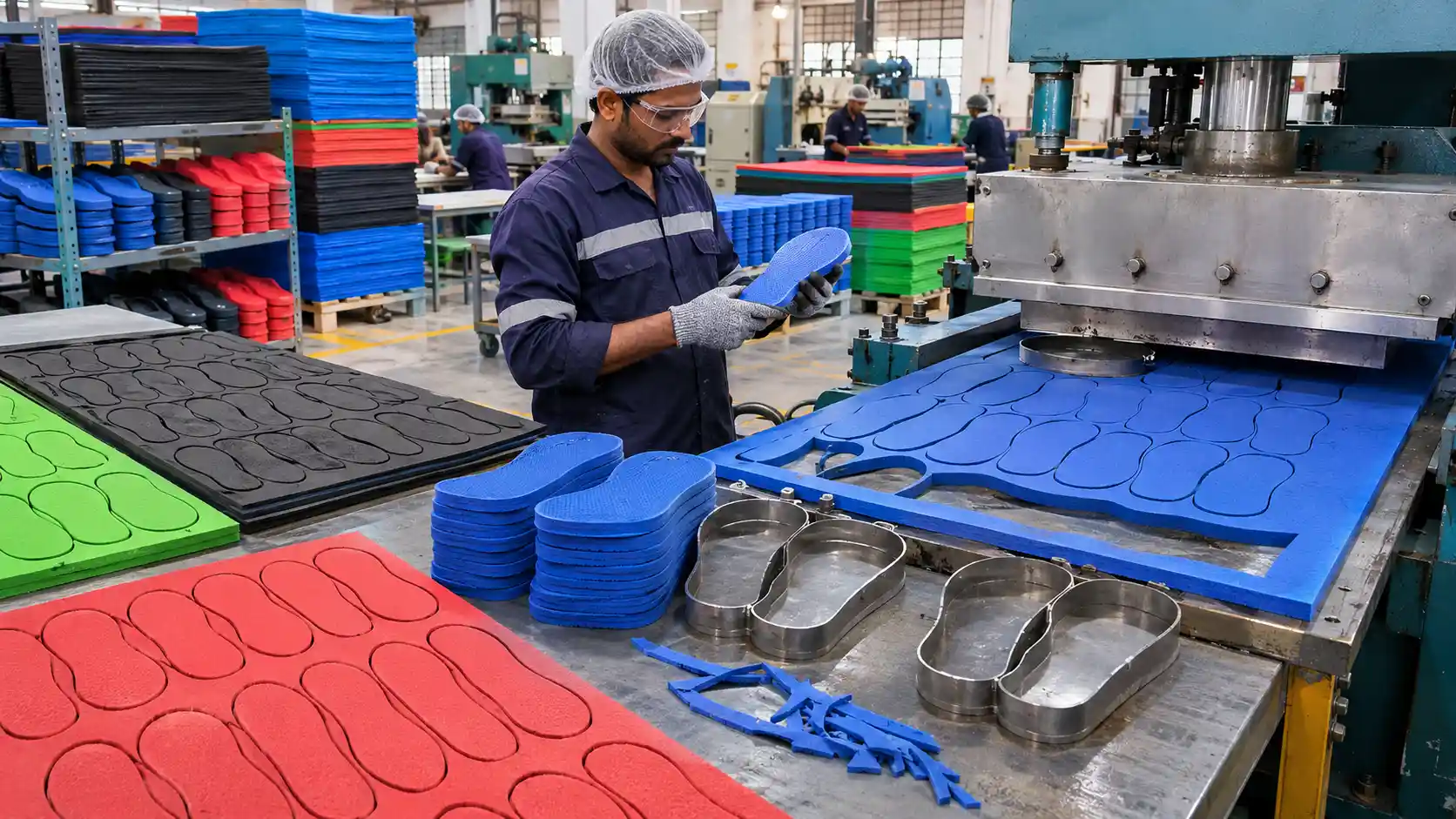
The Hawai chappal manufacturing consists of cutting EVA and rubber sole sheets into particular shapes and sizes to make up slipper soles. It can result in waste of material as a result of un-used edges, poor cutting patterns, rejected materials or poor die designs. These losses have a direct impact on production costs and material utilization. Using the right Hawai chappal sole sheet, judicious cutting layouts and equipment maintenance can help manufacturers to reduce waste and ensure the product's quality.
Waste has an impact on the cost of the slippers. The higher the sheet isn't used to capacity, the higher the material cost per pair. Excessive scrap can also affect the manufacturing productivity, material handling and inventory planning.
This is due to the shape and space between the individual soles, there are some offcuts that cannot be avoided. However, if the sheet selection isn't right, the die positioning is incorrect, and the sheet quality is inconsistent, then it can be an avoidable waste. Manufacturers can minimize these factors to maximize the efficiency of their production and the return of each sheet.
Effective planning, accurate cutting methods and regular quality control checks can help manufacturers to ensure that materials are used efficiently, waste is minimised and costs are kept to a minimum. The following are the various ways to reduce waste, while maintaining the shape, thickness and quality of the final slippers.
One of the easiest ways to minimise the amount of waste being cut is to choose appropriate sheet sizes. The length and width of Hawai chappal sole sheet should be according to cutting patterns, slipper size and available die combination which is used in the production.
Unnecessary wide and long sheets may result in unused large edge strips. Likewise with smaller sheets it may be possible to cut fewer soles at one time.
Bulk purchases should be considered after manufacturers are able to determine their regular production needs. Using different sheet sizes and actual cutting patterns can be used to determine the best fit and better utilisation of materials.
An effective die layout allows manufacturers to get more sole shapes from the sheet. Unnecessary gaps are also created and less usable pieces are obtained from each sheet due to poor positioning of cutting dies.
Manufacturers should ensure that the left and right slipper patterns are laid out in a logical sequence with the proper spacing between the dies. The layout of cuts should also take into account the die clearance, working dimensions of the machine and the direction of material flow.
Trial layouts can be useful in determining layouts that will give you a more complete sheet coverage prior to bulk production. Production output is more consistent; a well planned out layout minimises unused areas.
Nesting is the process of placing single cuts of pattern in a single pattern sheet to make the best use of the space. During manufacturing of slippers, one can optimise the nesting process by changing the direction of left and right sole shape.
Depending upon the design, for instance, a curved portion of one sole might fit into the restricted area near another sole. The edges of appropriate shapes can be joined to decrease gaps and improve the number of pieces that can be made from one sheet.
Variations in nesting should be considered prior to production. But a rotation or change of direction should not alter the direction of material, surface texture or printed designs. It is always necessary to have the desired product appearance and quality in the selected arrangement.
It is important that the thickness is consistent so as to ensure correct cutting and quality slippers. The cutting machine may find it difficult to cut the sole pieces evenly and cleanly as the thickness of the EVA sole sheet is uneven.
Similarly, any irregularity in the surface and cutting edge can affect the positioning and cut accuracy of the die. These issues can result in culling and/or some cuts being rejected.
The manufacturers must test the thickness uniformity, flatness and the surface defects and dimension accuracy of the incoming raw materials. Bending, deformation and unnecessary handling damage are also prevented with proper storage..
The importance of material waste control in the use of cutting equipment is very great. Worn edge of the die, machine pressure or cutting tool alignment can result in incomplete cuts or damaged sole shapes.
Inspection and maintenance is carried out regularly for cutting accuracy. Manufacturers should check the condition of cutting dies, ensure that the machine is aligned and adjust pressure according to thickness and property of material.
Cleaning of cutting surfaces and replacing worn or broken dies may also help to reduce production defects. By ensuring the proper maintenance of the equipment, it can be ensured that the cutting process is effective, reducing waste of defective products and contributing to the smoothness of production processes.
Usually the size of slipper production is different, and for each size, there is a corresponding cutting pattern. If not scheduled, creating different sizes can result in unused spaces on the sheet.
Before production, the manufacturers should check the orders, and estimate the number of slippers of each size before production. If sizes can be grouped together into production batches, then better die combinations can be determined and unnecessary pattern changes avoided.
An up-to-date slipper size chart also assists the operator with the choice of cutting dies. Using real demand in production planning can minimise overstock and increase the predictability of sheet utilisation.
Cutting yield is a measure that enables manufacturers to monitor the efficiency of their raw materials. They should count the quantity of all the accepted sole pieces from each sheet and the quantity of rejected pieces and wasted material.
If the dimensions, material properties and quality of the offcuts are suitable, they may be used for smaller parts or other purposes. Damaged, contaminated or undersized material should not, however, be used again in applications where it may impact on product performance.
Properly monitoring yields can help detect recurring waste patterns and offer valuable data to enhance cutting layouts and purchasing decisions.
Utilisation of materials is one of the significant parameters to assess the efficiency of a single sheet cutting process. It tells you how much area of the sheet is being used for acceptable sole pieces.
The basic formula is:
Material Utilisation (%) = (Accepted Sole Area ÷ Total Sheet Area) × 100
Imagine that you have a hypothetical example to consider:
Using the formula:
Material Utilisation = (7,200 ÷ 10,000) × 100
Material Utilisation = 72%
This is the equivalent to 72% of the sheet area being made into acceptable sole pieces.
Another important item to consider for manufacturers is finished-pair yield. An example of this is a sheet which yields 50 valid left and 50 valid right soles, giving a product of 50 pairs.
Area utilisation and finished-pair yield are different aspects of production. The ability to track both will give a better indication of material efficiency, rejected pieces, and actual manufacturing output.
Prior to bulk purchasing of the Hawai Chappal Sole Sheets, there are some quality assurance and quality control tests manufacturers must perform:
Additionally, manufacturers need to look at product specifications and batch consistency when assessing various Hawai chappal sole sheet suppliers.
The manufacturing processes can be incorrectly handled and it makes a lot of waste even if the sheets are of good quality. Here are some typical errors to avoid:
To avoid these mistakes, frequent inspection, regular training for the operators and consistent production monitoring is required.
AP Mats is aware of the importance of appropriate raw material in the footwear industry. Manufacturers need to use sole sheets which have the correct thickness, size, flexibility and surface properties to produce their sole sheet product.
We provide sheet materials for EVA, rubber for various needs of making slippers. Various thicknesses, colours, textures and application requirements can be taken into consideration when selecting products. These choices are used to help manufacturers determine which materials to use based on the end product and the available cutting equipment.
AP Mats is a sheet manufacturer and supplier in Delhi, and also a production oriented company in the field of manufacturing materials for footwear industry. Prior to ordering, buyers can discuss their sheet requirements, preferred specifications and quantities in bulk.
The use of appropriate sheets and sample cutting trials can enable customers to make informed decisions about their purchases and optimize material usage in production.
Cutting waste will play a vital role in costing efficiency and production performance of Hawai chappal industry. Materials can be used more efficiently by choosing appropriate sheet size, improving the structure of the dies, using efficient nesting methods and ensuring efficient cutting equipment. Standard measurements of the quality and calculations of the yield also help to identify and control unnecessary material losses more easily.
For the footwear manufacturing needs, AP Mats offers EVA and rubber-based Hawai chappal sole sheet. Manufacturers can discuss appropriate sheet specification and bulk purchasing to assist in maintaining uniformity in production and improved material planning.
Find answers to the most common questions about our products, services, ordering, delivery, and support.
The manufacturers can minimize the waste of cutting by choosing the appropriate size of the sheets, optimizing the die design and applying efficient nesting methods. Additionally, regular equipment maintenance, as well as scrap tracking, help to optimize material use.
Correct, non-uniform thickness of sole sheets can impact cutting pressure and cause incomplete or inconsistent cuts. To achieve accurate cutting results and to minimize the number of rejected pieces, the thickness should be uniform.
Material utilisation is the ratio of sole area accepted divided by the area of sheets used and multiplied by 100.
The sole sheets of Hawai Chappal are mostly made of EVA and rubber. It is dependent on the amount of flexibility, thickness, durability and weight that is required as well as the intended use of the slipper.
Sheet dimensions should be determined prior to choosing the size of the slipper, dimensions of the cutting die, and production requirements. Sample cutting trials can be used to help determine the optimum sheet size and minimise the amount of waste.
When used in the manufacturing process to check quality, they can be used to detect thickness, density, flexibility and surface finish variations before they are produced. This minimizes cutting blemishes, waste of soles and materials.

Yoga is a way to bring balance — between the body, the environment, and everything that connects us. Our materials must therefore portray that attitude.

Cows give their best when they feel good. When a cow is relaxed, she rests more, chews her cud longer, and digests her food better. That calm routine shows up in her milk output.

When your farm has a mixed herd cow mats give you flexibility whereas buffalo mats are preferred when the main importance is made on buffalo comfort.

Choosing the right dairy flooring can protect cattle from wet, cold, and slippery surfaces. Explore the benefits of rubber and EVA mats for modern farms.
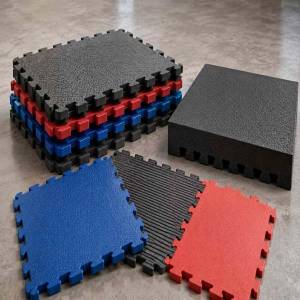
Discover EVA mats, their types, benefits, uses and buying tips. Learn how to choose durable EVA foam mats for gyms, play areas and flooring needs.
Transform Your Space with Premium Mats – Discover Durable, Stylish, and
High-Performance
Flooring Solutions Built to Last for Years.

Join our growing network and unlock exclusive benefits


