
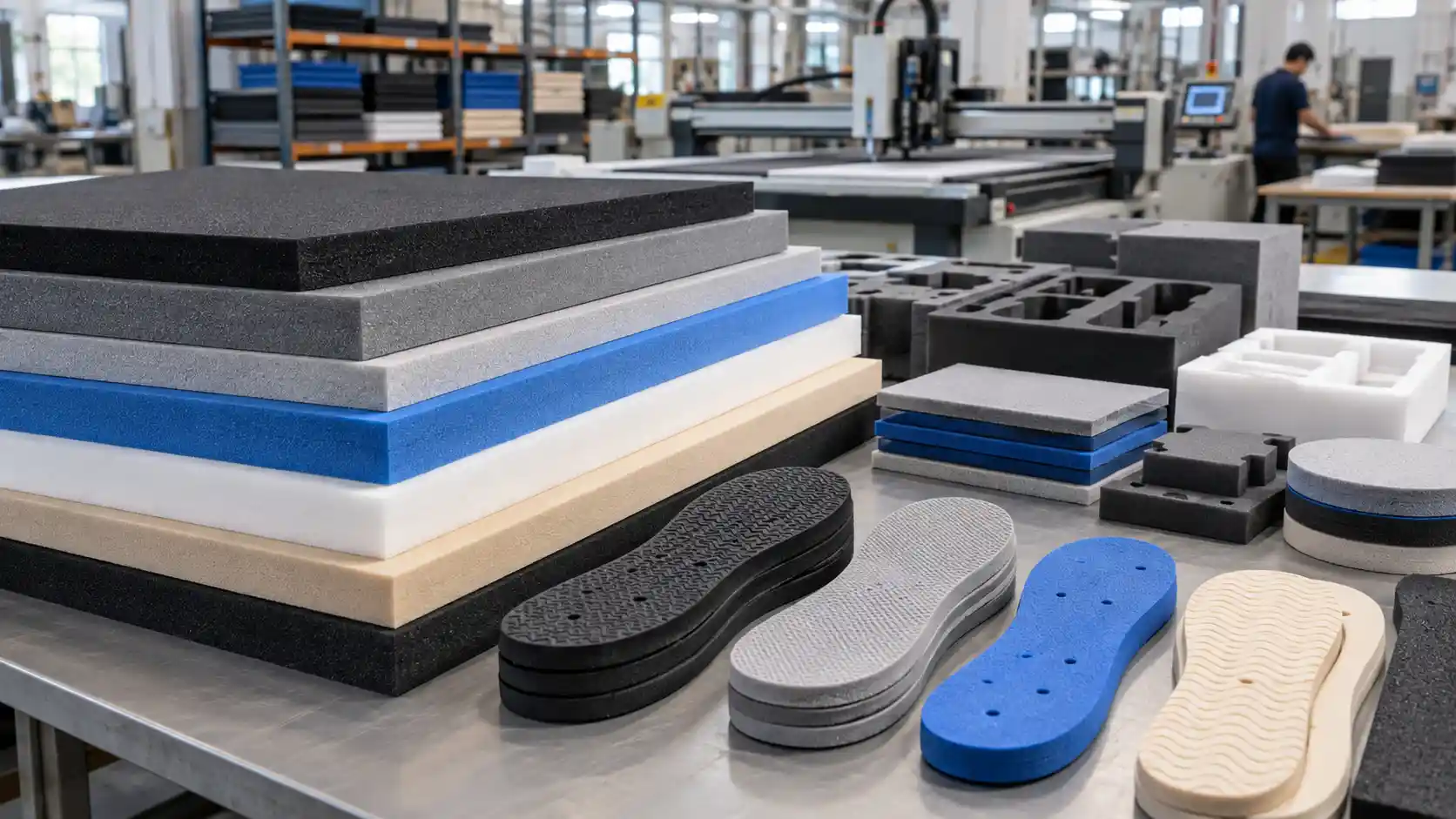
Squeeze a basic slipper sole between two fingers. It dips, then pops back. Chances are it’s EVA. The name stands for ethylene vinyl acetate, and the foam made from it now sits on the purchase list of most shoe units and plenty of industrial plants.
Why is it so popular? Mostly because it asks very little of you. A press, a die and some adhesive will take you a long way. Nobody needs a special setup to handle it.
An EVA sheet is foam in flat form. Chemically it’s a copolymer of ethylene and vinyl acetate, which sounds heavier than it feels in your hand. Think rubber, minus the weight.
At the plant, the raw compound is blended and heated. As the heat rises, tiny sealed cells form and the mix swells. The swollen slab is then pressed or moulded into sheets, and thickness, density and size get settled right there. Some sheets leave the line smooth. Others get an embossed face.
Before production starts, a buyer can usually decide a few things about the order:
That’s how one base material ends up in chappals, packing trays, yoga mats and insulation pads.
Take a stiff plastic part and flex it fifty times. It usually gives up. EVA doesn’t. Press it, bend it, let go, and the sheet returns to shape. That single trait explains a good share of its sales.
Then there’s cushioning. The sealed cells absorb shock instead of passing it on, which is exactly what a sole or a packing insert has to do. Water is the next point. The sheet takes in very little, so damp floors and rainy-season use don’t spoil it. And the weight? Pick up a sheet and you’ll wonder if anything is in your hand.
A few quieter features help too. Heat moves through the foam slowly, and noise gets dulled. Strong sunlight and common cleaning liquids take a long time to damage it. Cutting, gluing, laminating and embossing need only regular tools.
So the grade you pick decides the job. Thin and soft suits light footwear. Dense and thick suits heavy packing.
Walk through any footwear market and look at the soles. A large share of them were cut from EVA sheets. Slippers, sandals, Hawai chappals, sports shoes. The foam keeps the pair light, even when someone is on their feet from morning till night.
Three sole materials dominate the trade: Hawai chappal sole sheets, rubber sole sheets and slipper sole sheets. Which one a maker picks depends on the design, the comfort aimed for and how rough the wear will be.
Picture a stack of sheets beside a cutting press. That’s a Hawai chappal sole sheet. It’s ready for the die, in whatever size or pattern the order needs.
The sheet is soft, so workers don’t fight it. Cut the sole, fix the strap, check the pair, move on. A few things keep makers coming back:
Most of the comfort comes from that softness. Cost stays down too, and chappal brands watch that closely.
Rubber does a different job. It’s denser than EVA, so it wears slowly and grips well. Shoes that live on rough roads or wet floors need that.
Work shoes, casual shoes, heavier sandals and hard-use chappals often get rubber soles. Cut and finished properly, the sole holds its footing. Buyers usually bring up these points:
EVA and rubber don’t replace each other. Many shoe factories keep both in stock, because one gives comfort and the other gives traction.
Slippers are mostly worn indoors, on tiles, for short walks. A slipper sole sheet is built for that. Casual slippers, home footwear, light sandals. It’s the soft layer your foot actually meets.
Makers look at thickness, softness and sole design first. Go thicker and you get more cushion. Go medium density and the sole keeps its shape longer while still feeling kind to the foot. Common reasons for choosing it:
For brands after a light and low-cost sole, EVA slipper sole material is an easy pick. It cuts and bonds without fuss, and batches stay close to each other in quality.
Plenty of EVA never goes near a foot. The plant needs it to be cushioned, protected, insulated, and as material for manufactured products. The encased cells and limited water absorption enable it to compete in tough environments.
Typical uses:
Ever watched how a courier tosses a carton? Packaging has to expect that. EVA sheets used for packaging take the impact instead of the product, and they hold items in place so nothing slides about inside a carton or crate.
Packers cut EVA foam packaging sheets into inserts, liners, corner guards and dividers. Electronics, glassware, machine parts and medical equipment all travel better in them. A tray can be cut around one specific item, and tools or small components can each get a snug pocket.
Light weight matters here as well. The foam adds very little to freight cost. And since it doesn’t soak up much water, goods crossing humid regions are better protected.
Insulation and flooring make up another big area. Industrial EVA sheets slow down heat, dampen vibration and sit as a soft barrier where two hard surfaces meet.
In workshops you’ll find it under flooring, wrapped around equipment or laid beneath machines as vibration matting. Gym mats, yoga mats and interlocking floor tiles are made from the same material. Its common roles include:
Where weight is a concern, EVA foam insulation sheets are a good fit. They resist heat, take impact and hold their shape for a long time.
Begin with the product, not the catalogue. What must it do? How will your team cut and bond it? Two EVA sheets can behave very differently if density, thickness or finish isn’t the same.
Before a bulk order, go through this list:
For footwear, comfort, flexibility and sole design lead. For industrial jobs, density, impact resistance, insulation and stable dimensions lead.
Manufacturers keep reordering EVA for a practical reason. One material covers comfort, protection and easy handling. Change the density, thickness or finish, and it moves from a pair of sandals to a machine pad.
Reasons buyers give most often:
AP Mats makes EVA sheets for footwear, packaging, insulation, sports goods and industrial use. Customised specifications, consistent quality and bulk supply are all on offer.
In the shoes it will be used as chappal soles, slipper soles, sandals and cushions while in industries it will be used as packing inserts, insulation, vibration dampening pads and flooring material.
The choice of the correct sheet will depend on various factors such as density, thickness, flexibility, surface finish and environmental exposure of the product. A small sample test before bulk purchase will save a lot of problems.
|
AP Mats manufactures EVA foam sheets for use in footwear, packaging, insulation, sports goods and industrial sectors. For more information and bulk purchases contact us. |
Find answers to the most common questions about our products, services, ordering, delivery, and support.
Footwear soles, slippers, sandals, packaging inserts, insulation, protective padding, sports mats, and industrial pieces are all examples of the uses of EVA sheets. They are used in a variety of manufacturing processes because of their cushioning, flexibility and moisture resistant properties.
Yes. Due to their shock absorbency, flexibility and lightweight, EVA sheets are commonly used in the production of Hawai chappals, slippers, sandals and sports shoes.
The EVA sole sheet is lighter and softer with excellent cushioning. Rubber sole sheets offer greater abrasion, grip and durability.
Yes. EVA sheets can be provided with various thicknesses, densities, colours, sizes and surface finishes depending on the manufacturing needs.
The structure of EVA sheets is closed-cell foam and has moisture repellent properties. They are good for footwear, packaging, outdoor applications and moist conditions like bathrooms.
For a particular application thickness should be chosen. Packaging or industrial parts might need more thickness or density of cushioning layers, and footwear might need softer cushioning laye

Yoga is a way to bring balance — between the body, the environment, and everything that connects us. Our materials must therefore portray that attitude.

Cows give their best when they feel good. When a cow is relaxed, she rests more, chews her cud longer, and digests her food better. That calm routine shows up in her milk output.

When your farm has a mixed herd cow mats give you flexibility whereas buffalo mats are preferred when the main importance is made on buffalo comfort.
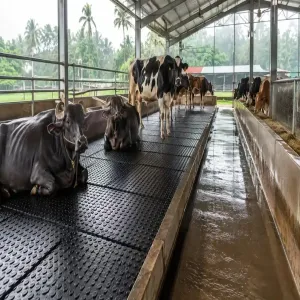
Choosing the right dairy flooring can protect cattle from wet, cold, and slippery surfaces. Explore the benefits of rubber and EVA mats for modern farms.
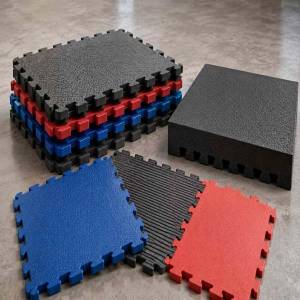
Discover EVA mats, their types, benefits, uses and buying tips. Learn how to choose durable EVA foam mats for gyms, play areas and flooring needs.
Transform Your Space with Premium Mats – Discover Durable, Stylish, and
High-Performance
Flooring Solutions Built to Last for Years.

Join our growing network and unlock exclusive benefits


